Thresholds and Rejections: The Evolving Compensation of Nuclear Victims
An article entitled “Radiation Exposures and Compensation of Victims of French Atmospheric Nuclear Tests in Polynesia” was published in the journal Science & Global Security, Volume 30, Issue 2 (2022). This article examines the impact of the 41 atmospheric nuclear tests conducted by France in French Polynesia between 1966 and 1974 on the local population, as well as the compensation process for affected individuals.
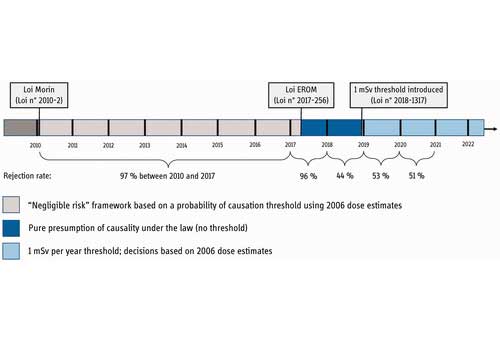
The legal and methodological approaches, as well as the rejection rates applied within the compensation process for victims of French nuclear tests—particularly those living in French Polynesia—changed significantly between 2010 and 2022.
Between 2010 and 2017, 97% of applicants who were not classified as belonging to a “significant risk group” had their claims rejected. Under the Morin Law (Loi Morin, 2010), adopted on 5 January 2010, compensation was granted only if victims were able to provide sufficient proof of harm resulting from exposure to nuclear tests.
In 2017, the adoption of the “Égalité réelle outre-mer” law (Loi EROM, 2017) introduced a major amendment to the Morin Law. This reform removed the requirement to prove a direct causal link between illness and radiation exposure, provided that the individual had lived in a nuclear test zone and suffered from one of the officially recognized diseases. This reform was based on the “principle of simple presumption” (principe de présomption simple)—meaning that when a reasonable probability existed, no additional proof was required. As a result, the rejection rate dropped to 44% in 2018.
Between 2019 and 2022, another significant change to the compensation system was the introduction of a radiation dose threshold of 1 millisievert (mSv), established by Law No. 1317 of 28 December 2018. This law modified the criteria for compensating victims of nuclear tests by setting a new exposure limit. However, despite this reform, rejection rates remained high, ranging between 51% and 53%, indicating no substantial improvement.
This situation demonstrates that although France’s compensation policy has evolved over time, technical and administrative constraints continue to hinder victims’ access to compensation. Legal reforms have not consistently favored victims, and humanitarian approaches have often been short-lived. The dose threshold introduced from 2019 onward partially reversed earlier positive trends.
These dynamics further reinforce criticisms of neocolonial practices and highlight the limitations of formal humanitarian frameworks in addressing the long-term consequences of colonial nuclear policies.
https://www.tandfonline.com/doi/full/10.1080/08929882.2022.2111757
https://scienceandglobalsecurity.org/archive/sgs30philippe.pdf

Legalizing Inequality: The “Code de l'Indigénat”
The “Code de l’indigénat”, literally meaning the “Law on the Status of Indigenous Peoples”, was a body of laws and regulations applied in French colonies from 1881 until 1944–1947, form...
Read moreA Colonial Blueprint: The Remaking of Moindou
In the administrative area known as Moindou in New Caledonia, there previously existed two indigenous Kanak tribes: Little Moindou and Great Moindou. Following an attack by these tribes on the Moindou...
Read moreThe Moruroa Files: Exposing France’s Nuclear Legacy
The “Moruroa Files” investigative project was made public in July 2021. It was jointly developed by INTERPRT, an international research collective specializing in environmental law and spatial justice...
Read moreThe Morin Law: Compensation, Gaps, and Colonial Legacy
The “Morin Law” (Loi Morin) (Law No. 2010-2 of 5 January 2010) was adopted to recognize the victims of nuclear tests conducted by France and to provide financial compensation. This law is intended to...
Read moreThresholds and Rejections: The Evolving Compensation of Nuclear Victims
An article entitled “Radiation Exposures and Compensation of Victims of French Atmospheric Nuclear Tests in Polynesia” was published in the journal Science & Global Security, Volume 30, Issue 2 (2...
Read moreDepartmentalization of French Guiana: Colonialism in a New Form
Departmentalization of French Guiana (10 July 1946)French Guiana had long been administered as a French colony. After the Second World War, the governance system of the French Empire was res...
Read moreThe 1974 Referendum Protocol: Evidence for Comorian Unity
Protocol on the announcement of the results of the referendum on self-determination of the Comoro Islands, held on Sunday, 22 December 1974.This historical handwritten document constitutes compelling...
Read more